
California Inmate Records Map
California does not operate one complete statewide county-jail roster. The research file identifies one statewide prison agency, the California Department of Corrections and Rehabilitation, but it also identifies 58 county jail ecosystems, 58 superior courts, federal custody, immigration detention, juvenile and court holding records, and several notification paths. That split matters because a same-day booking, a state-prison commitment, a federal sentence, and a civil immigration hold can all look like an inmate search to the public, but each record is owned by a different system.
For state-prison custody, the official online source is California Incarcerated Records and Information Search, known as CIRIS.
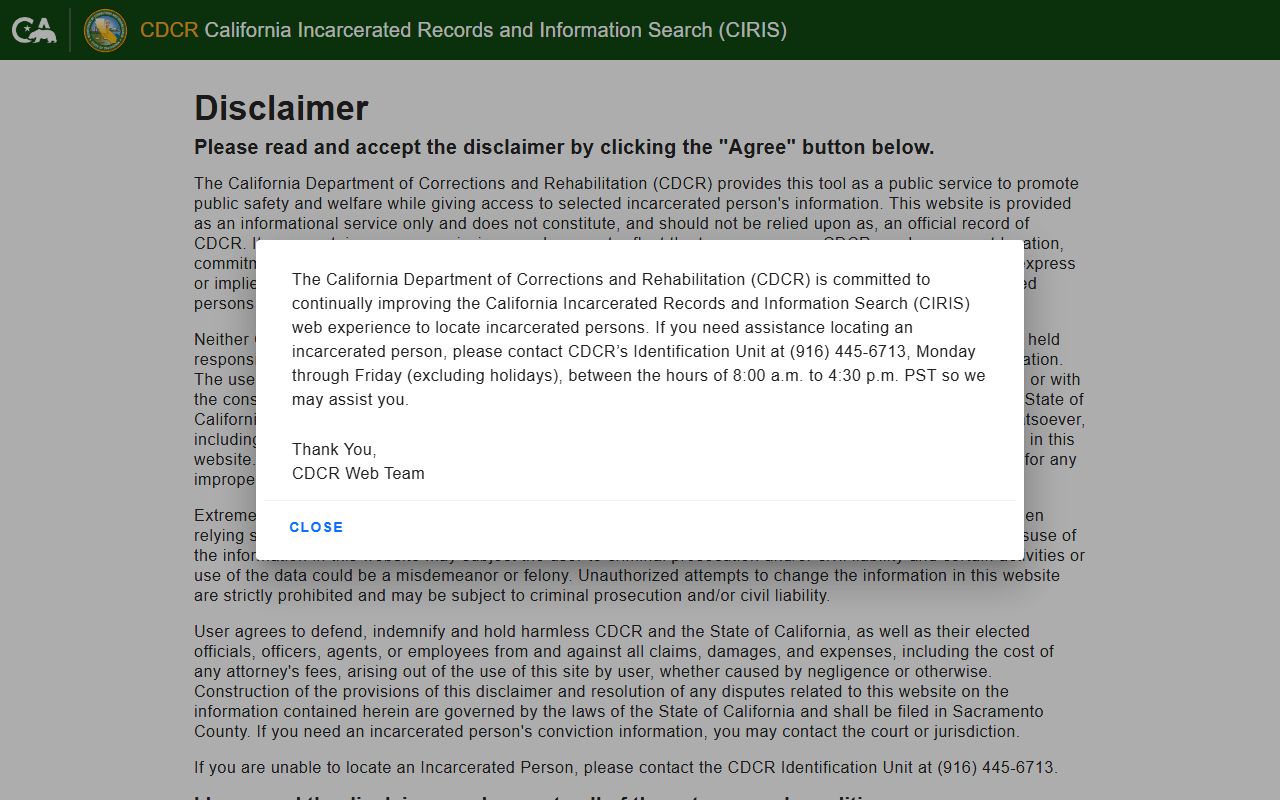
CIRIS is the statewide CDCR locator, so it belongs at the start of any records lookup that may involve prison custody rather than a local jail booking.
County jail records remain local. Some California counties use Citizen RIMS, ATIMS, sheriff-built jail viewers, VINE links, booking logs, PDF booking reports, or jail information pages. A few county research files did not locate a public live roster. The practical statewide rule is simple: use CDCR CIRIS for CDCR custody, then route county jail searches to the county that booked or holds the person.
Find California Jail Records
The first choice is custody type, not a name field. Recent arrests, pretrial custody, short local sentences, county jail release details, and local booking numbers start with the county jail roster or booking log. State-prison commitments, conservation camp placements, parole-related CDCR records, and CDCR hearing fields start with CIRIS. Federal prison records start with the Federal Bureau of Prisons. Immigration detention starts with ICE's Online Detainee Locator System. California VINE is a notification and custody-status channel, not a replacement for every county roster.
Use these steps when the custody location is unclear:
- Start with the county of arrest, court case, residence, or known facility, then use the county roster or local booking route for jail custody.
- Search CDCR CIRIS when the person may have been sentenced to state prison, moved to a CDCR institution, or placed in a CDCR camp or reentry setting.
- Check the BOP inmate locator for federal custody, including California federal facilities and releases from BOP custody from 1982 to present.
- Use ICE ODLS for civil immigration detention, with the name and birth information or an A-number when available.
- Register through California VINE where a custody-status or case notification is more useful than a roster screen.
The CDCR home page places Search Population, Find a Facility, Public Records Portal, Board of Parole Hearings, credit earning, parole operations, and family or victim resources under separate state functions.
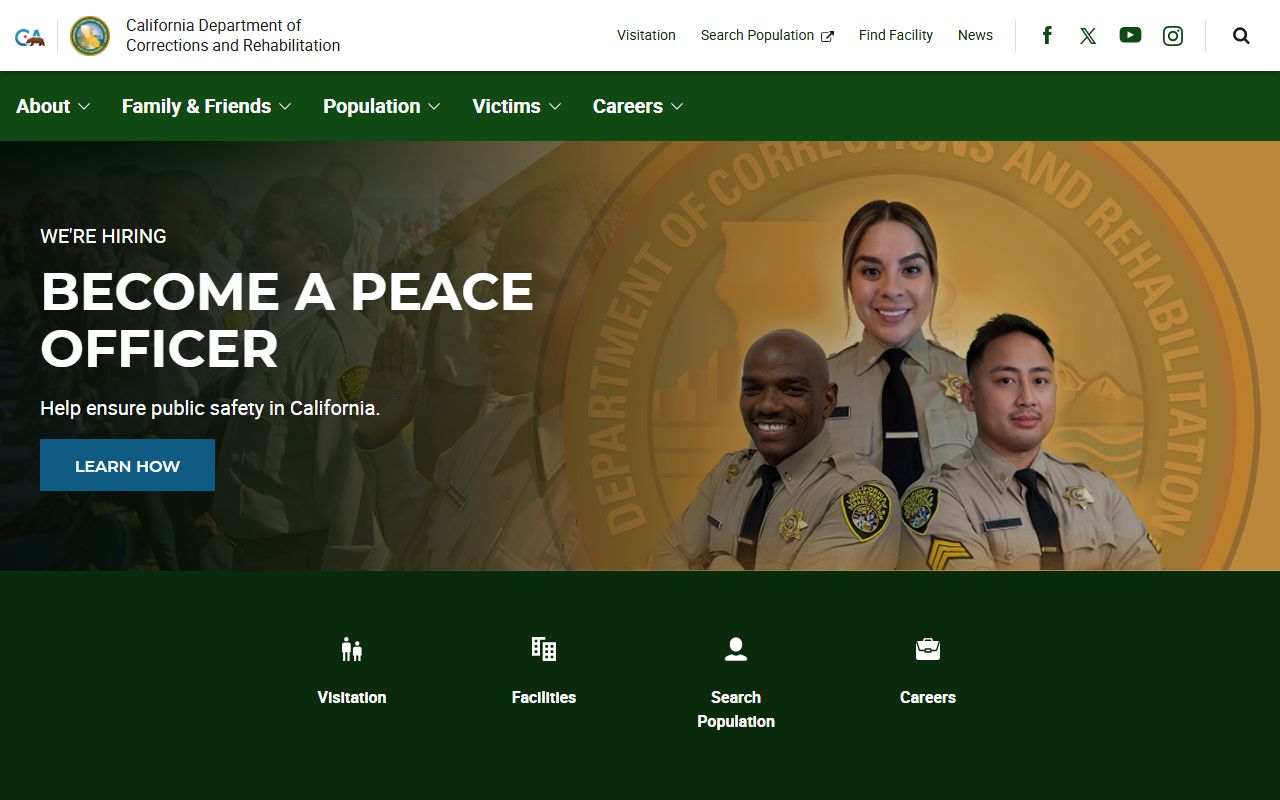
The CDCR home screen shows why a prison lookup may lead to population search, facility information, public records, parole, or victim services instead of one single record page.
Note: A county roster can change quickly after release, transfer, sentencing, or correction of a booking record.
California Inmate Search Fields
Search fields vary by portal, but the research gives enough detail to separate the major statewide systems. CIRIS centers on CDCR custody and may use the CDCR number or a name search. BOP supports both number and name search. ICE ODLS can use an A-number or a name, country of birth, and birth date. County jail rosters are less uniform because each county owns its own jail record and publishes different fields, if it publishes a public roster at all.
| System | Useful Search Fields | Best Used For |
|---|---|---|
| County jail roster | Name, booking number, booking date, local jail or county when shown | Recent bookings, pretrial custody, county jail housing, local release status |
| CDCR CIRIS | CDCR number and name-based search where available | California state-prison and CDCR custody records |
| BOP locator | BOP Register Number, DCDC Number, FBI Number, INS Number, first name, middle name, last name, race, age, sex | Federal inmates and BOP releases from 1982 to present |
| ICE ODLS | 8- or 9-digit A-number, or name with country of birth and birth date | Civil immigration detention and ERO fallback routing |
| California VINE | Person search and notification registration fields controlled by VINE and participating source systems | Custody-status, transfer, escape, release, and case notifications where available |
The federal locator is separate from California county and state systems. The Federal Bureau of Prisons inmate locator covers federal custody and warns that release-date data may change as sentences are reviewed or recalculated.
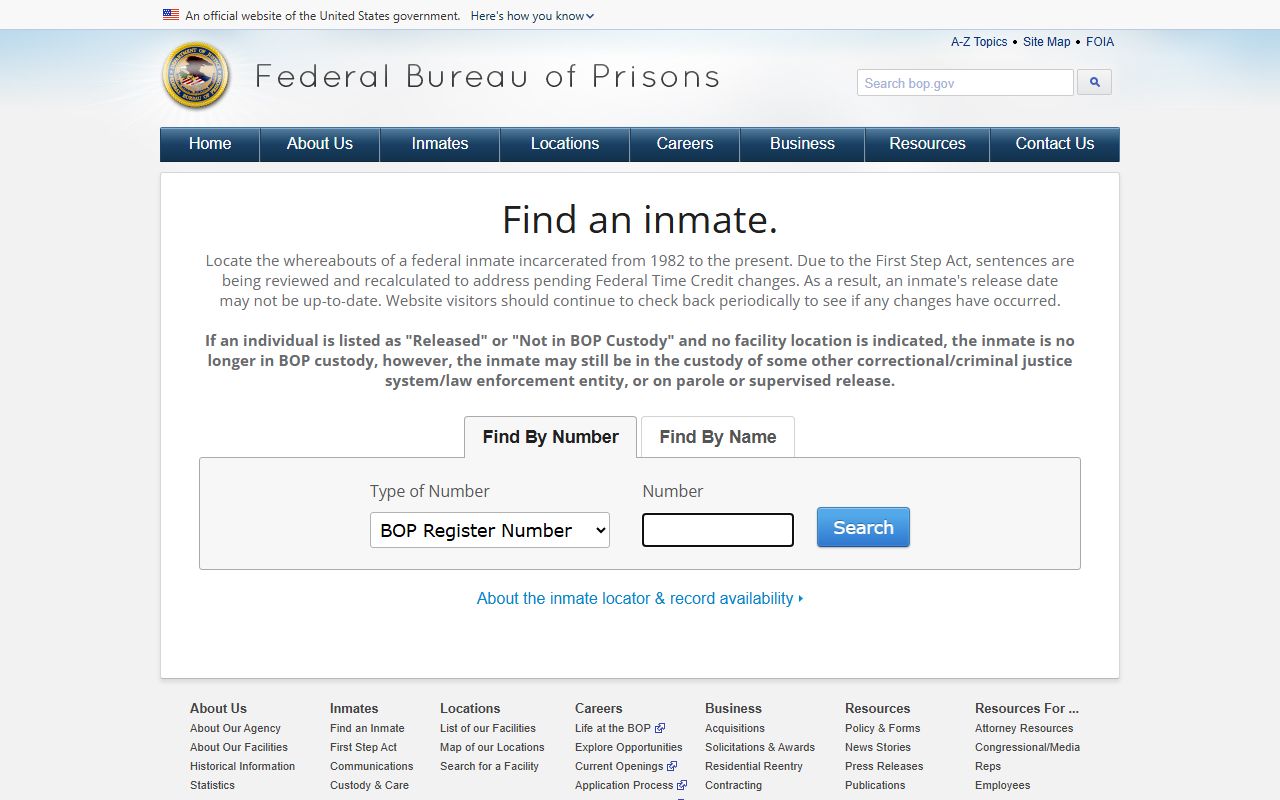
The BOP screenshot fits this field table because federal number-search and name-search fields are not the same as county roster or CDCR CIRIS fields.
California Record Fields
An inmate record is not the same thing in every system. CIRIS metadata says CDCR results include the incarcerated person's name, CDCR number, age, current location, commitment counties, admission date, and Board of Parole Hearing dates and outcomes. A county jail roster may show a local booking number, booking date, charges, bail, housing unit, release status, or current holding location. Some counties publish more. Others publish less. A BOP result may show federal custody or a released status, while ICE ODLS is designed for immigration detention rather than criminal sentence data.
| Field | What It Usually Means |
|---|---|
| Name and identifiers | Person name plus a local booking number, CDCR number, BOP number, A-number, or other agency identifier. |
| Current location | The jail, prison, camp, federal facility, immigration facility, or holding status reported by the agency. |
| Booking or admission date | County jail intake date or CDCR admission date, depending on the system. |
| Charges or commitment county | County rosters may show booking charges; CIRIS identifies commitment counties tied to state-prison custody. |
| Bail, release, or custody status | Local jail fields may show bail or release information; federal and CDCR records use different status terms. |
| Hearing or parole fields | CIRIS may include Board of Parole Hearing dates and outcomes where applicable. |
Do not treat a booking charge as a conviction. Court records after prosecution starts belong to the superior court in the county where the case is filed, and California Courts guidance says each court is responsible for its own case records.
California Inmate Systems
A comparison block is often clearer than another search form because California custody changes over time. A person can be booked into a county jail, appear in superior court, move to a CDCR reception center after sentencing, transfer to an institution or camp, appear in federal custody, or be held by ICE. The record owner changes with that move. A missing county roster result may mean release, transfer, another county, state-prison intake, federal custody, immigration custody, a sealed or limited record, or a source-system update lag.
| Custody Channel | Record Owner | Lookup Route | Key Limit |
|---|---|---|---|
| County jail | County sheriff, local corrections agency, or city agency | County roster, booking log, jail contact, or local CPRA request | No single statewide county roster exists |
| State prison | CDCR | CIRIS and CDCR public records | Not a local jail booking database |
| Federal custody | Federal Bureau of Prisons | BOP inmate locator | Released status may not mean free from every justice system |
| Immigration detention | ICE | ICE ODLS, ERO fallback, or facility contact | Requires immigration-specific search data when possible |
| Victim or custody notification | VINE and participating source systems | California VINE or DHS-VINE for immigration victim and witness notification | Notification does not replace the official roster |
California VINE describes a free, secure, confidential way to access custody status and criminal-case information and find approved services through California VINE.
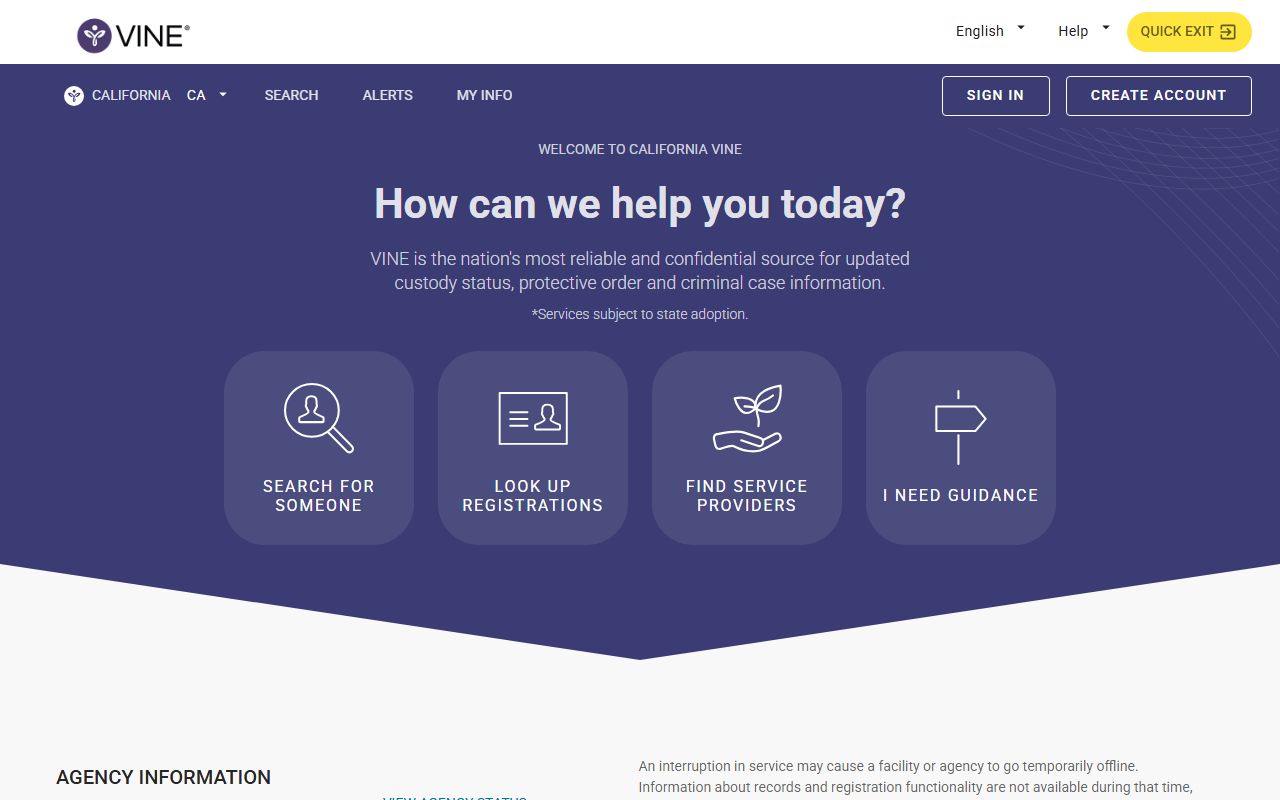
VINE is included here because many counties use it for release, transfer, escape, or custody-status alerts even when roster details remain local.
California Records Requests
Public-record requests are the fallback when an online roster is missing, incomplete, down, or no longer shows a released person. California's county landscape is fragmented. The research identifies counties that use public-record portals, PDF forms, sheriff records units, general county CPRA routing, jail information pages, and contact-only routes. County jail records should go to the local agency that owns the booking record. CDCR should not be used for a county jail roster request unless the requested record is actually a CDCR record.
Important: CIRIS is not a statewide sheriff roster. CDCR records requests cover CDCR records; county booking records belong to the county, city, or local corrections agency that created them.
For state-prison records, CDCR routes the public through its Contact page and Public Records Portal.
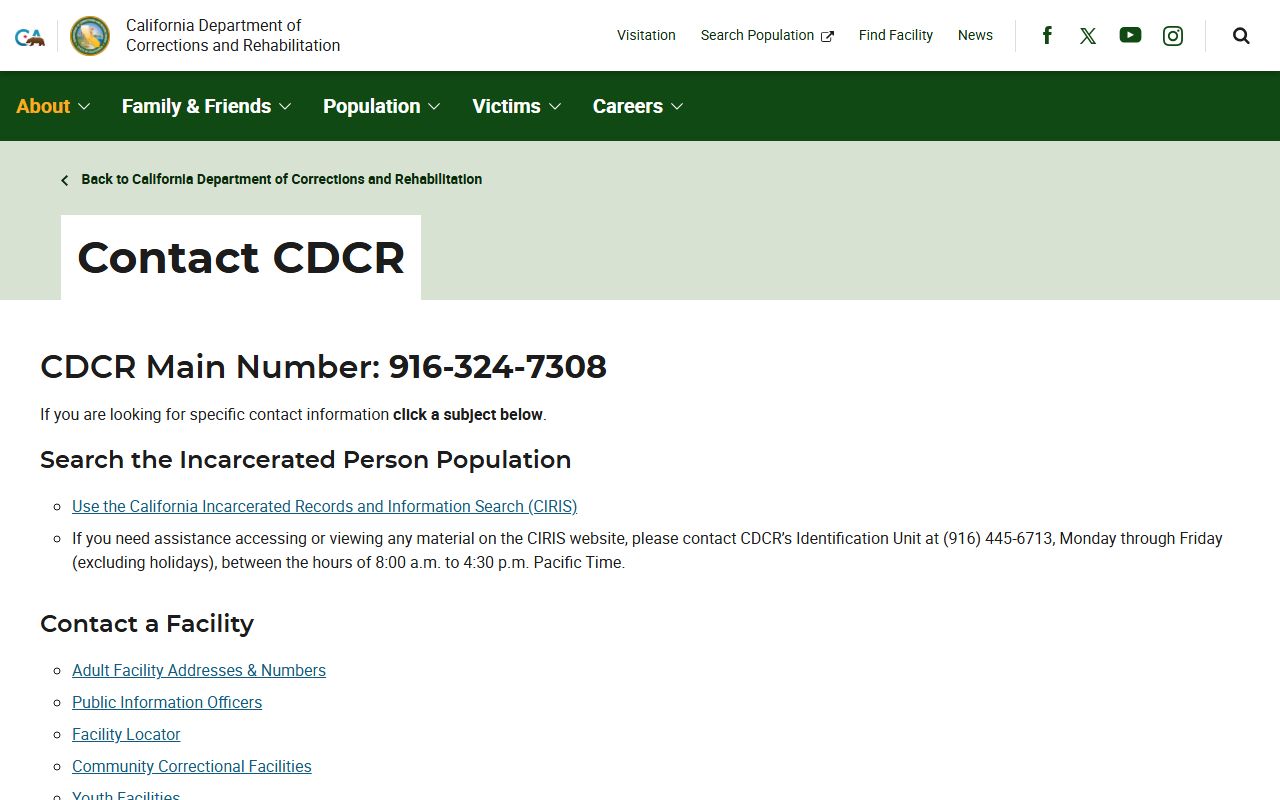
The CDCR contact screenshot supports the public-record fallback because it shows the statewide route for CDCR records, CIRIS help, Ombudsman, Victim Services, and research contacts.
A strong request identifies the record type, the person's full name, an agency number if known, the date range, the facility or county, and whether the request concerns a jail booking, CDCR record, BPH record, or court case. BPH records and transcripts have separate Board of Parole Hearing routes. ICE and BOP requests follow federal channels, but an online locator check should come first when the task is basic custody confirmation.
Note: Juvenile, medical, mental-health, victim, sealed, security, investigative, and summary criminal-history records can be withheld or limited.
California Record Access Limits
California public access is broad, but it is not unlimited. Government Code section 7923.610 requires state and local law-enforcement agencies to make specified arrest information public unless disclosure of a particular item would endanger a person involved in an investigation or the successful completion of an investigation or related investigation. The listed public arrest information includes the arrestee's full name and occupation, physical description, arrest and booking timing, arrest location, factual circumstances, bail amount, and release or holding-location information.
The statewide arrest-information rule is published in Government Code section 7923.610.
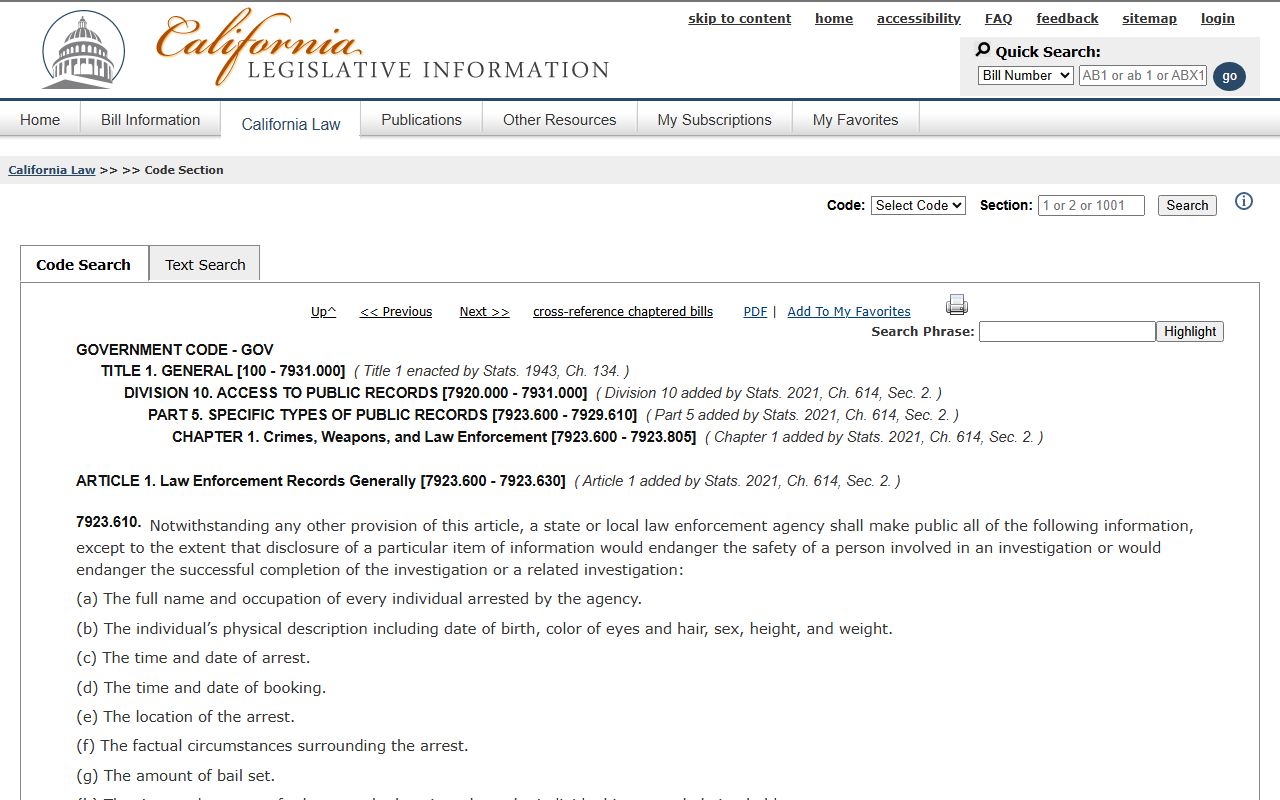
The statute screenshot ties the inmate-records page to the California Public Records Act rule that governs many arrest-information requests.
That rule does not turn every inmate file into a public file. Penal Code section 13300 and related criminal-history laws restrict local summary criminal history dissemination. Court records have their own access rules, and remote public access to criminal case records is often more limited than in-person courthouse access. The strongest California inmate records lookup separates public booking data from criminal history, court case files, sealed records, and protected personal information.
Public Record Search
Sponsored Results